No Hot Water? Electric Water Tank Troubleshooting Guide
If your electric water tank is not working and you have no hot water, there are a few basic checks tenants should complete before a technician is booked. In many cases, the issue may be caused by the water tank switches being turned off, the timer being set incorrectly, the thermostat/controller not being set correctly, or the boost function not being used when required.
The electric hot water tank is usually located in the storage room, airing cupboard, or utility cupboard. Before opening a maintenance task, please follow the safe troubleshooting steps below.
Tenants are responsible for checking the external switches, timer, thermostat, and controls before reporting the issue. If the issue continues after these checks have been completed, please open a maintenance task with the required photos so we can arrange the correct technician without unnecessary delays.
Important Safety Notice
- Do not remove any covers from the water tank or immersion heater.
- Do not touch wiring or attempt any electrical repair yourself.
- Only check the external switches, timer, thermostat, and controls.
- If you notice leaking, burning smells, sparks, overheating, or electrical damage, stop using the system and report the issue immediately.
- If you are unsure, do not attempt to adjust anything internally. Open a maintenance task instead.
Step-by-Step Checks
1. Locate the electric water tank
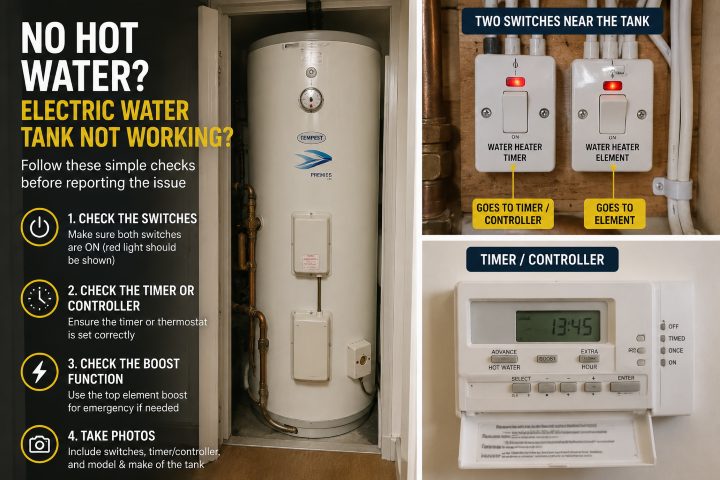
The water tank is generally located in a storage cupboard, airing cupboard, or utility room. Once you find the tank, look for the switches nearby.
2. Check the two switches near the tank
Most electric water tanks have two switches near the cylinder. Please make sure both switches are turned on. Where fitted, a red light should usually be visible on the switch when it is on.
If the switches were off, turn them on and allow enough time for the water to heat before reporting the issue. The boost function may heat some water faster, but a full tank can take longer.
3. Check the timer, thermostat, or controller
Some electric water tanks are controlled by a timer, thermostat, or separate hot water controller. Please check whether the system is set to continuous, timed, boost, or off. If the timer, thermostat, or controller is set incorrectly, the water may not heat at the expected time.
If there is a thermostat, timer, or controller, please check the make and model number. You can usually find the user manual online by searching the make and model on Google. There are also several online manuals and YouTube videos showing how different thermostats and timers operate.
Please only check the external settings. Do not remove any covers, touch wiring, or attempt any electrical repair. If you are unsure how to operate the thermostat or timer after checking the manual, please open a maintenance task and upload clear photos of the controller.
Please take a clear photo of the current thermostat, timer, or controller setting before opening a maintenance task.
4. Check the boost switch
Many electric hot water cylinders have two heating elements:
- The lower element is usually connected to the main timed or continuous hot water setting.
- The upper element is often used as a boost or emergency top-up function.
The boost function can usually be used if you urgently need hot water, but it is generally intended as a short-term or emergency option. It should not normally replace the main timed hot water setting.
5. Check whether the water has had enough time to heat
If the switches, timer, or controller were previously off, the tank will not produce hot water immediately. Please allow the tank enough time to heat the water before submitting a repair request.
Heating times can vary depending on the size of the tank, the system settings, and whether the boost or main heating element is being used.
6. Do not adjust internal thermostats or wiring
Some water tanks have thermostats located behind covers on the immersion heater. These should not be opened, adjusted, or repaired by tenants. If the external controls are on and the tank is still not heating, please open a maintenance task.
Photos and Information Required
If the electric water tank is still not working after completing the checks above, please open a maintenance task in the system. To help us arrange the correct technician without delays, please upload:
- A clear photo of the water tank/cylinder
- A clear photo of the two switches near the tank, showing whether the red lights are on
- A clear photo of the thermostat, timer, or controller, if there is one
- The make and model of the thermostat, timer, or controller, if visible
- A photo of the make and model label on the tank, if visible
- A photo or video showing the issue, where possible
- Confirmation that both switches have been checked and are on
- Confirmation that the thermostat, timer, or controller settings have been checked
- Confirmation that you have checked the manual or online instructions for the thermostat, timer, or controller, where available
- Confirmation that the boost function has been checked, if available
- Confirmation that the water has been given enough time to heat after the checks were completed
When to Report the Issue
If you have completed the troubleshooting steps and the electric water tank is still not producing hot water, please open a maintenance task in the system. We can then review the information and arrange a technician where required.
Please note that by submitting a maintenance task, you are confirming that the basic checks above have already been completed. This helps avoid unnecessary contractor visits and allows us to book the correct technician more quickly.
Possible Contractor Charges
If a technician attends and the issue is found to have been caused by the switches being off, the timer or thermostat being incorrectly set, the boost function not being used where required, the water not being given enough time to heat, or the tenant not completing the basic checks above, a call-out charge may be recharged to the tenant.
If the electric water tank has a genuine electrical, mechanical, or heating element fault not caused by tenant use, the landlord will normally be responsible for arranging the repair.